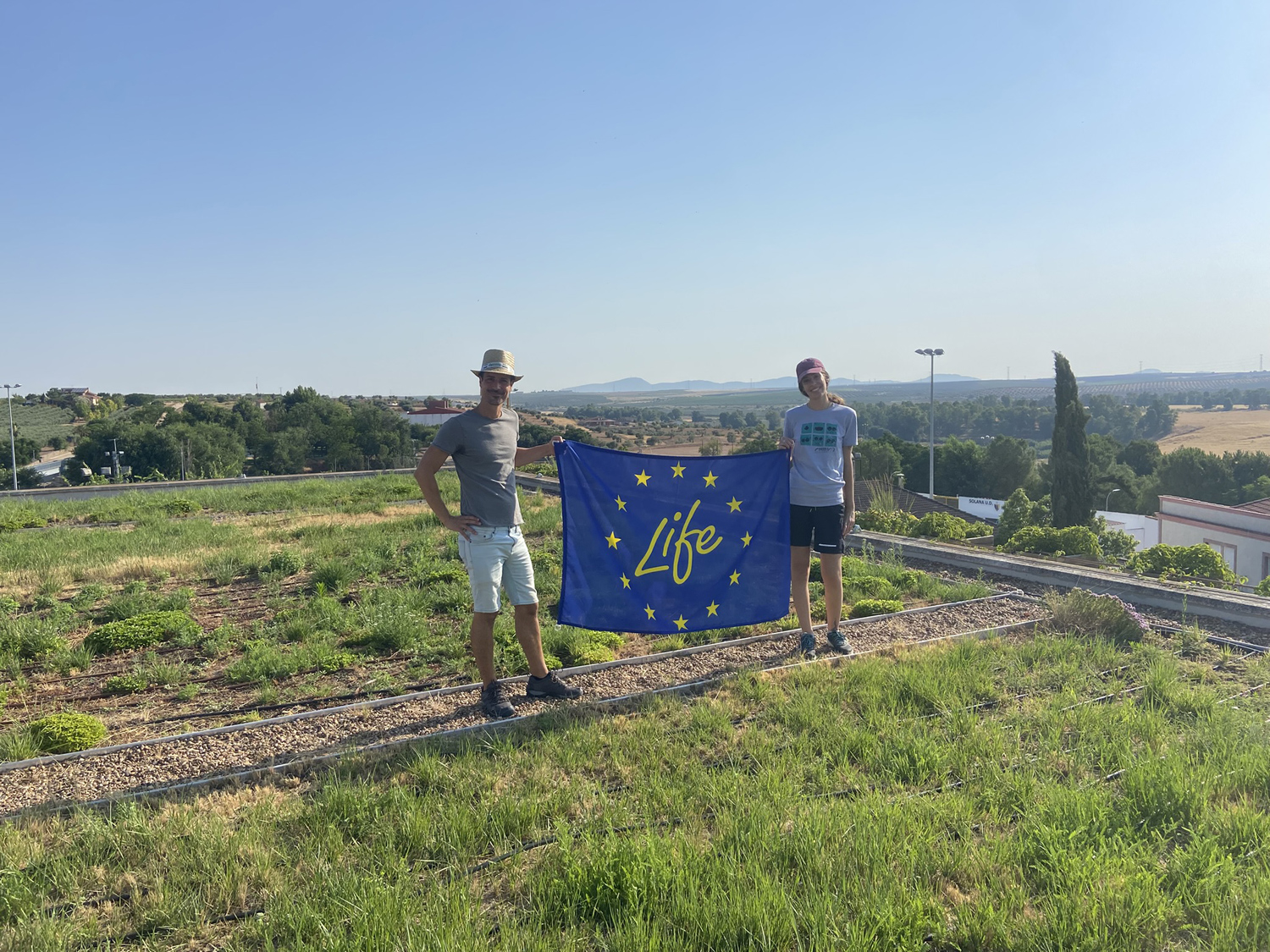
Following visits in previous years to the EB1 Falcão school in Porto, the CEIP Gabriela Mistral school in Solana de los Barros (Badajoz), and the EBI Horta das Figueiras school in Évora, experts from the RJB-CSIC will return in July 2025. Although these surveys were scheduled to take place in 2024, they had to be postponed until the following summer due to organizational and timing issues.
Following the same methodology and objectives established in previous events, and in collaboration with the respective technicians, the fourth year of biodiversity sampling has been carried out at the centers. During the sessions, specimens of bryophytes and lichens were collected for subsequent identification in the laboratory, the plant species present were identified in situ, and pitfall traps were set up for sampling invertebrates. All of this will make it possible to assess how the presence of Nature-based Solutions (NbS), designed and implemented by the LIFE-myBUILDINGisGREEN project, influences local biodiversity and its abundance.
The newly collected data will help build a more comprehensive picture of the ecosystem’s evolution at the school and contribute to a more accurate understanding of the real impact of NbS on biodiversity, as well as their medium- and long-term effectiveness. This analysis will focus on detecting possible increases or changes in species diversity, as well as in the presence and abundance of indicator species (e.g., Armadillidium).

Condition of the pond installed in Falcão as a NbS. Photo from Jul 2025 © LIFE-mBiG
The sample identification process was carried out at the RJB-CSIC thanks to the joint work of the centre’s researchers and students from the Master’s Degree in Tropical Biodiversity and Conservation, a programme offered by the International University Menéndez Pelayo and taught on the premises of the RJB-CSIC itself.
Although further analysis and a more detailed study of current and future results are still required, the overall trend observed in terms of species presence and abundance is positive. In the case of Porto, at the start of the project, the total number of species recorded did not exceed 70, while currently it is above 140. The same is true in Évora and Solana de los Barros, where the number has risen from 30 to 116 and from 20 to more than 100, respectively. This increase has been particularly notable in plant species, although it has also been observed in invertebrates. Furthermore, although the most significant increase occurred shortly after the installation of the SbNs, this improvement has been maintained over time. It is expected that this trend will be consolidated in the sampling carried out in the coming years and that biological diversity will gradually stabilize.
 Campanula sp. observed in Jul 2025 © LIFE-mBiG
To obtain more robust results, further sampling will be ecessary to support the existing data, especially the one scheduled for spring 2026. The After-LIFE Plan, which will soon be available in the results section of the project’s website, includes this upcoming sampling to increase both the quantity and reliability of the data (2026), as well as additional surveys to assess the long-term impact of NbS on local biodiversity (2026–2028)
To stay up to date with all the latest news related to LIFE-myBUILDINGisGREEN, we recommend following the project’s Twitter and LinkedIn channels.


